

Table of Contents
On October 14, 2026, Square announced a self-service kiosk with a conversational AI voice layer that lets restaurant customers ask questions, change their orders, and get recommendations out loud. If you’re a small restaurant owner, the question isn’t whether the demo is impressive — it’s whether a $1,999 machine plus $99 a month actually pays for itself. Here’s what an AI kiosk for a small business restaurant really costs in year one, what the voice layer can and can’t do, what diners think of kiosks, and how Square compares to the alternatives.
What Square actually launched
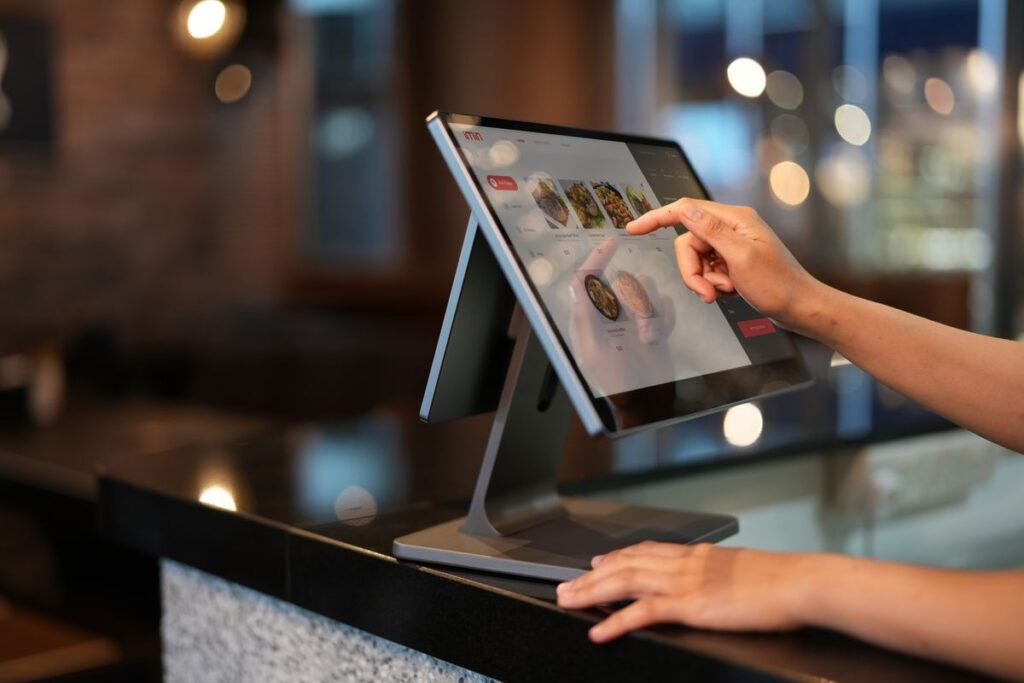
Square Kiosk is the company’s new flagship self-service terminal for quick-service restaurants, announced via press release on October 14, 2026. The hardware is a 21.5-inch touchscreen paired with what Square calls an “agentic, conversational voice layer” that, in Square’s words, fully understands a seller’s menu (Business Wire).
In practical terms, guests can:
- Ask questions about menu items, ingredients, and allergens in plain speech
- Request modifications and explore substitutions
- Get personalized recommendations and real-time upsell suggestions based on popular items, the time of day, and what’s already in the cart
- Switch between voice and touch at any point during the order
- Check in with Square Loyalty accounts and earn or redeem rewards
- Pay with integrated contactless and card payments, or scan gift cards with the built-in barcode scanner
The hardware includes presence detection that greets approaching guests, and three directional microphones with AI noise filtering. Square also shipped a multi-account management layer for franchises — centralized menu management, multi-location reporting, and enterprise gift card administration, while (Square says) franchisees keep autonomy over their own locations (Fast Casual).
Two pilot operators are quoted in Square’s release: Baltej Sra (CEO, Boba Nation Grand) said the kiosk “exceeded our expectations” with rollout planned to remaining locations; Lawrence Kam (multi-unit L&L Hawaiian BBQ operator) said he was “genuinely skeptical of kiosks” but now wants them “throughout our national footprint” — company-selected testimonials (Business Wire).
It is part of the wider shift toward AI agents taking real actions in small-business operations, rather than simply answering questions.
The real price: every line item
Square published its pricing upfront, which is refreshingly direct for restaurant tech. Here’s the full stack:
- Hardware: $1,999, which includes the countertop stand. One independent analyst’s Oct-19 breakdown notes Square also offers hardware at about $97 a month over 24 months on Block-issued credit plans — that’s a third-party report, not Square’s own headline price (LinkedIn/Sandeep Raiza).
- Kiosk software: $99 per month, per device.
- A required Square for Restaurants plan: $49 per location per month for Plus, or $149 for Premium.
- Payment processing: 2.5% + 15¢ on every tap or dip.
So a single location running one kiosk on the Plus plan pays roughly $3,775 in year one before a single processing fee ($1,999 + $1,188 + $588) — one industry breakdown puts the hardware-plus-kiosk-software cost alone at about $3,190 in the first year, before the Plus or Premium subscription (Revscale). Each additional device adds another $1,999 upfront and $99/month. Card processing stacks on top of all of it.
Two limits worth knowing, per independent launch coverage: the launch is currently US-only and English-only, and Square itself advises that the voice ordering may not suit extremely noisy environments, where it recommends touch instead (LinkedIn/Sandeep Raiza; Unite.AI). This is announcement coverage and Square’s pilot data, not a hands-on independent review — no independent reviewer has put one through a real dinner rush yet.
What the voice layer can and can’t do
The voice layer is the genuine novelty: the kiosk listens and responds in real time, its time-of-flight sensor wakes the screen as guests approach, and Square recommends spacing multiple kiosks at least 24 inches apart so the microphones don’t pick up neighboring orders (Unite.AI).
The honest caveats:
- A misheard order costs you a remake. Voice accuracy with accents, background noise, and complicated custom orders is the make-or-break question, and it will only be answered by real-world use. A kiosk that confidently mishears an order is worse than one that never listened (KiS 24/7).
- Reliability across the category is poor. Canopy’s 2026 Restaurant Tech Report found that only 20% of kiosk users said the devices work every time — unchanged from the previous year — and 37% of customers said they have left a restaurant without completing an order because the technology wasn’t working. That survey is about kiosks in general, not Square’s device, but it’s the reliability bar the new hardware has to clear (QSR Web/Canopy).
- Confusing interfaces sink kiosks. Tillster’s 2026 Phygital Index found 31% of diners cite confusing interfaces as a primary reason kiosks fail, and 23% are frustrated when they can’t redeem loyalty points seamlessly on-premise (Tillster).
Square isn’t the only voice bet in town; voice AI is already voice AI answering restaurant phones.
What diners actually think of kiosks
The industry data is a mix of enthusiasm and resistance, and restaurant owners should read both sides:
- Resistance is real. Per Technomic survey data cited by Restaurant Business in its Oct-13 launch coverage, 35% of diners find ordering from a kiosk unappealing and 46% say the same of voice AI in the drive-thru, while ordering at the counter with an employee remains the most popular method at 46% (Restaurant Business).
- But kiosk users are often satisfied. Tillster’s 2026 Phygital Index reports that 64% of diners now order via in-store self-service kiosk multiple times per month (up from 61% in 2025), and 71% say they’re equally or more satisfied ordering via a kiosk compared to a cashier.
- Kiosks move the numbers. Among restaurants with kiosks, 76% report reduced wait times and 67% report higher average check sizes, in a 2026 operator study — the upsell engine Square is selling has measurable precedent (Restaurant Technology News).
- Don’t force it. Satisfaction is 4% lower when customers order online versus in person — the industry’s conclusion: be available wherever the customer wants to interact, via app, kiosk, or employee (Restaurant Business).
The pattern: diners accept kiosks when they feel faster and more personal, and resent them when they’re funneled into the only option.
Square vs. the alternatives
Context matters. A day before Square’s announcement, Toast — the restaurant-tech incumbent, serving about 180,000 locations — added AI scheduling tools and beta marketing agents of its own (Revscale). When Square’s kiosk went live, Toast’s shares fell more than 4.5% in midday trading and closed down 3.37% — a market reaction to competitive pressure, not evidence about which kiosk is better (Stocktwits; The Inference).
How the money compares (published and third-party-guide figures, October 2026):
- Toast: $1,454 Guest Self-Service kit, or $0 hardware with higher processing; kiosk software around $69/month per third-party guides (Gingerserve).
- Otter: $100–$289/month lease by kiosk size, or purchase outright; $99/month per device software (TryOtter).
- GRUBBRR: around $3,000–$6,000+ hardware with $95–$125/month software (TryOtter).
- Square’s older kiosk app (a different product — an app on your own hardware): $50 per device per month on Plus, $30 on Premium (Gingerserve). The new Square Kiosk’s $99/month is a separate, higher tier tied to the new hardware.
Toast sells hardware at a loss and earns on payments moving through it; Square’s new kiosk bills the terminal, the software, and the swipe as three separate lines (The Inference). On a $50 check, the processing-rate gap between major platforms is pennies — what actually separates the platforms on cost is the software tiers, the add-ons, and the hardware (Chowly).
The honest ROI math for a small restaurant
Forget the headline $1,999. Run your own numbers:
- Total year-one cost: ~$3,775 for one kiosk on Square Plus (hardware + $99/mo kiosk software + $49/mo Plus), plus 2.5% + 15¢ on every transaction it processes. Two kiosks? Roughly $7,400 before processing.
- The labor offset: Square pitches the kiosk as absorbing the lunch rush so staff can focus on order prep and hospitality — not as staff replacement. If the register line costs you overtime or walkaways, price that pain first.
- The check-size lift: Square’s upsell engine suggests add-ons by popularity, time of day, and cart contents. The category precedent is real (67% of kiosk operators report higher check sizes), but treat Square’s pilot-store lift figures as a hypothesis to measure, not a promise.
- The reliability tax: Until independent reviewers test the voice layer in a noisy dining room, budget for failure modes — remakes from misheard orders, and customers who won’t talk to a machine.
Who should buy it — and who shouldn’t
Strong fit: high-volume quick-service spots where the register line is the bottleneck, multi-unit operators who can use the franchise management layer, and Square-native restaurants where the kiosk drops into existing menus, loyalty, and payments with no middleware.
Weak fit: loud dining rooms (Square itself says use touch there), concepts where human hospitality is the product, and operators without a rush problem to solve.
Square’s own pitch is the right framing: use it to cover the rush, not to replace your people. Count your rush, test it on your real menu with real customers, and get the final price and fees from Square before you sign anything (KiS 24/7).
Your 5-step decision checklist
- Price the pain first. How many walkaways or how much overtime does your noon rush cost you monthly? If the answer isn’t concrete, the kiosk is a gadget, not a solution.
- Run the three-year math. ($1,999 + $99/mo + required Plus/Premium) × devices, plus processing. Compare against the labor and lost-sales numbers from step 1.
- Test the voice on your actual menu. Ask for your hardest custom orders. A demo on a simple menu tells you nothing.
- Keep a human lane open. The data is clear: diners resent being funneled into the only option. Voice, touch, and a staffed counter should coexist.
- Measure the upsell claim. Run the kiosk for 90 days and compare average check size against your baseline. Square’s pilots liked it — verify it in your store.
How much does the Square AI Kiosk actually cost?
The hardware is $1,999 including the countertop stand, plus $99 per month per device for the kiosk software, plus a required Square for Restaurants Plus ($49/location/month) or Premium ($149/location/month) subscription, plus 2.5% + 15¢ payment processing on every transaction. Year one for a single kiosk on Plus runs about $3,775 before processing fees.
Can customers talk to the Square Kiosk, or is it touch-only?
Both. The kiosk combines a 21.5-inch touchscreen with an AI conversational voice layer that understands the restaurant’s menu — customers can ask questions, request modifications, and get recommendations by voice, and switch between speaking and tapping at any point. Square advises using touch in extremely noisy environments.
Should a small restaurant buy an AI kiosk in 2026?
It depends on your bottleneck. If the register line costs you walkaways or overtime during rushes, a kiosk with a proven upsell engine can pay back — Square’s ~$3,775 first-year cost per device is the number to beat against your own labor and lost-sales math. If your dining room is loud, your concept sells hospitality, or your rush is mild, wait for independent reviews of the voice accuracy first.
Sources
- Square press release (Business Wire, 2026-10-14)
- Fast Casual (2026-10-14)
- PYMNTS (2026-10-14)
- The Inference (2026-10-15)
- Revscale Media (2026-10-17)
- Unite.AI via europesays (2026-10-14)
- KiS 24/7 (2026-10-16)
- Restaurant Business — Square kiosk launch + Technomic survey figures (2026-10-13)
- QSR Web / Canopy 2026 Restaurant Tech Report
- Tillster 2026 Phygital Index
- Restaurant Technology News operator study (2026-01)
- Otter fast-food kiosk cost guide
- Gingerserve QSR POS cost comparison
- Chowly Toast vs Square (June 2026)
Was this article helpful?